
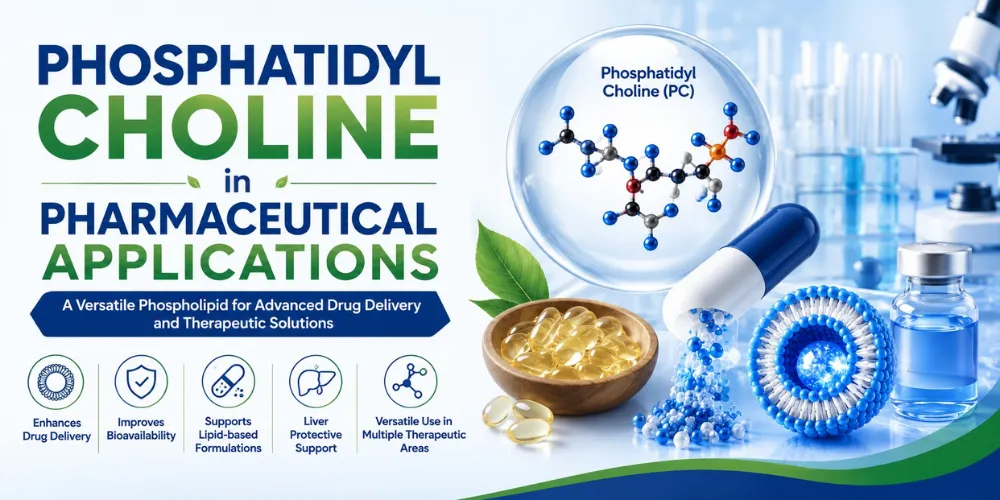
Phosphatidyl Choline in Pharmaceutical Applications
Introduction
Phosphatidyl Choline plays a critical role in modern pharmaceutical science. It is not just a biological compound. It is also a powerful functional excipient.
In our experience working with formulation teams across different markets we have seen a clear shift. Pharmaceutical companies are moving toward advanced delivery systems. Traditional formulations are no longer enough.
Phosphatidyl Choline supports this transition. It enables better drug delivery and improves therapeutic outcomes when used correctly.
This article explains its role in pharmaceutical applications. It focuses on drug delivery systems and liposomal formulations. It also shares real formulation insights that are often overlooked.
What is Phosphatidyl Choline in a Pharmaceutical Context
Phosphatidyl Choline is a phospholipid found in cell membranes. It has both hydrophilic and lipophilic properties.
This dual nature makes it highly valuable in drug delivery.
In pharmaceutical formulations it is used as:
• An emulsifier
• A carrier molecule
• A structural component in lipid systems
These functions are essential for improving drug performance.
Why Drug Delivery Systems Need Phosphatidyl Choline
One of the biggest challenges in pharmaceuticals is bioavailability.
Many active compounds fail because they cannot reach the target site effectively.
Phosphatidyl Choline helps solve this problem.
Key Benefits in Drug Delivery
• Enhances solubility of poorly water soluble drugs
• Improves absorption across biological membranes
• Reduces toxicity in certain formulations
• Supports controlled and sustained release
These benefits are not theoretical. We have seen measurable improvements in formulation performance when high quality phospholipids are used.
Role in Liposomal Drug Delivery Systems
Liposomal technology is one of the most important areas where Phosphatidyl Choline is used.
Liposomes are small vesicles made from phospholipids. They mimic natural cell membranes.
Phosphatidyl Choline forms the core structure of these vesicles.
How Liposomes Work
Liposomes encapsulate active ingredients.
They protect the drug from degradation.
They deliver the drug to specific tissues.
Phosphatidyl Choline enables the formation of stable bilayers. This is essential for liposome integrity.
Types of Pharmaceutical Applications
Phosphatidyl Choline is used in a wide range of pharmaceutical products.
1. Injectable Formulations
It is used in lipid based injectable systems.
These systems improve drug solubility and reduce irritation.
2. Oral Drug Delivery
It enhances absorption in oral formulations.
It is often used in lipid based capsules and suspensions.
3. Topical and Transdermal Systems
Phosphatidyl Choline improves skin penetration.
It is used in creams gels and patches.
4. Targeted Drug Delivery
It supports targeted delivery in advanced therapies.
This is especially relevant in oncology and chronic disease management.
Our Approach to Quality and Supply
At Amitex Agro Products Pvt Ltd we focus on delivering consistent and high purity phospholipid solutions.
We support pharmaceutical companies with application specific guidance.
Our Phosphatidyl Choline products are designed to meet global requirements.
You can explore our product here:
https://www.amitexindia.com/products/phosphatidyl-choline-pc
We also supply products tailored for international markets including Thailand. Our team understands regulatory and quality expectations for these regions.
Conclusion
Phosphatidyl Choline is a key enabler in modern pharmaceutical formulation.
It improves drug delivery. It supports liposomal systems. It enhances product performance.
