
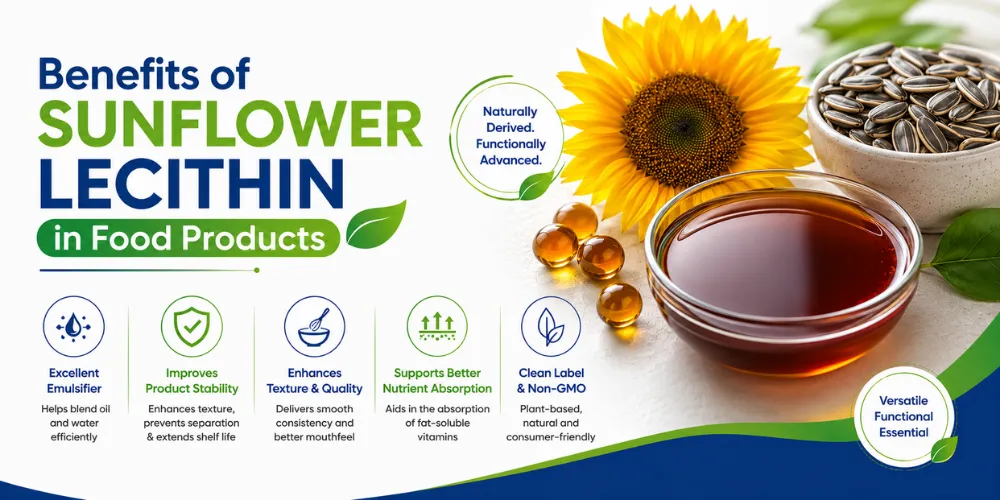
Benefits of Sunflower Lecithin in Food Products
Introduction
Sunflower lecithin is now widely used in food manufacturing. It is not a new ingredient. It has been part of industrial food processing for many years. But its importance has grown in recent times.
Food companies today want clean label ingredients. They also want better texture stability and consistency. Sunflower lecithin helps solve these problems.
In this article you will learn how sunflower lecithin works in food products. You will also understand where it adds value in real applications.
What is Sunflower Lecithin
Sunflower lecithin is a natural emulsifier. It is extracted from sunflower seeds. The process does not require harsh chemicals.
It contains phospholipids. These molecules have both water loving and fat loving properties. This makes them useful in mixing oil and water.
Unlike some other lecithin's, it is often non-GMO. This is one reason why food brands prefer it.
Why Food Manufacturers Use Sunflower Lecithin
Food production is not simple. Many products contain both oil and water. These do not mix naturally.
Without an emulsifier, products may be separated. Texture becomes unstable. Shelf life reduces.
Sunflower lecithin solves these issues. It helps maintain uniform structure. It improves product quality.
“In practical food processing lecithin is not optional. It is essential for stability and consistency especially in emulsified systems.”
Key Benefit 1: Improves Emulsification
Emulsification is the core function of sunflower lecithin. It allows oil and water to mix.
This is important in products like chocolate margarine sauces and dressings.
Without proper emulsification:
-
Oil separates
-
Texture becomes uneven
-
Product quality drops
With sunflower lecithin:
-
Stable mixtures are formed
-
Uniform texture is maintained
-
Product looks and feels consistent
Key Benefit 2: Enhances Texture and Mouthfeel
Texture defines consumer experience. A product may taste good, but poor texture reduces acceptance.
Sunflower lecithin improves:
-
Creaminess in dairy products
-
Smoothness in chocolate
-
Softness in baked goods
It reduces graininess. It improves spreadability.
In chocolate manufacturing, lecithin reduces viscosity. This helps in processing and improves the final texture.
“Texture is one of the first quality signals for consumers. Lecithin plays a silent but critical role in shaping that experience.”
Key Benefit 3: Supports Clean Label Requirements
Consumers today read labels carefully. They avoid artificial additives.
Sunflower lecithin fits well into clean label trends. It is:
-
Naturally derived
-
Plant based
-
Often non GMO
This makes it suitable for brands that want transparency.
Key Benefit 4: Improves Shelf Life
Shelf life is a major concern in food production. Products must remain stable during storage.
Sunflower lecithin helps by:
-
Preventing oil separation
-
Reducing oxidation
-
Maintaining uniform structure
This leads to longer shelf life. It also reduces product returns.
It is especially useful in:
-
Bakery products
-
Instant mixes
-
Confectionery
Key Benefit 5: Enhances Powder Dispersion
Instant powders must be dissolved quickly. Poor dispersion leads to lumps.
Sunflower lecithin improves wettability. It helps powders absorb water easily.
This is useful in:
-
Protein powders
-
Beverage mixes
-
Nutritional supplements
It ensures smooth mixing without clumping.
“In instant food systems dispersion speed directly affects consumer satisfaction. Lecithin improves that first interaction with the product.”
Key Benefit 6: Reduces Production Costs
This benefit is often overlooked.
Sunflower lecithin reduces viscosity in products like chocolate. This allows manufacturers to use less cocoa butter.
Cocoa butter is expensive. Reducing its use lowers production cost.
It also improves process efficiency. Machines run smoother. Energy consumption may reduce.
Key Benefit 7: Suitable for Allergen Sensitive Formulations
Some consumers avoid soy based ingredients. This creates demand for alternatives.
Sunflower lecithin is a good option. It is:
-
Soy free
-
Gluten free
-
Suitable for allergen sensitive products
This helps brands expand their product range.
Applications in Food Products
1. Chocolate and Confectionery
Sunflower lecithin reduces viscosity. It improves flow during processing. It gives a smooth texture.
2. Bakery Products
It improves dough handling. It enhances softness. It extends shelf life.
3. Dairy and Dairy Alternatives
It stabilizes emulsions. It improves creaminess.
4. Instant Foods
It improves dispersion. It ensures lump-free mixing.
5. Sauces and Dressings
It prevents oil separation. It maintains consistency.
“Across applications, the role remains the same. Stability of texture and consistency. These are the pillars of good food formulation.”
Sunflower Lecithin vs Other Lecithins
Sunflower lecithin is often compared with soy lecithin.
Key differences:
-
Sunflower lecithin is often non-GMO
-
It is allergen friendly
-
It fits clean label trends better
Soy lecithin is still widely used. It is cost-effective. But market preferences are slowly shifting.
Real Industry Insight
In real manufacturing environments small formulation changes can create big differences.
For example in instant beverage powders adding sunflower lecithin improves dispersion significantly. Without it users often complain about lumps.
In chocolate processing even a small percentage of lecithin improves flow properties. This directly affects production efficiency.
These are not theoretical benefits. They are observed in daily production.
Conclusion
Sunflower lecithin is more than just an emulsifier. It is a functional ingredient that improves multiple aspects of food products.
It enhances texture. It stabilizes emulsions. It improves shelf life. It supports clean label goals.
For food manufacturers, it offers both technical and commercial advantages.
As consumer expectations evolve, the demand for ingredients like sunflower lecithin will continue to grow.
“The future of food lies in smart ingredients that solve real problems. Sunflower lecithin is one such ingredient that delivers consistent value.”
