
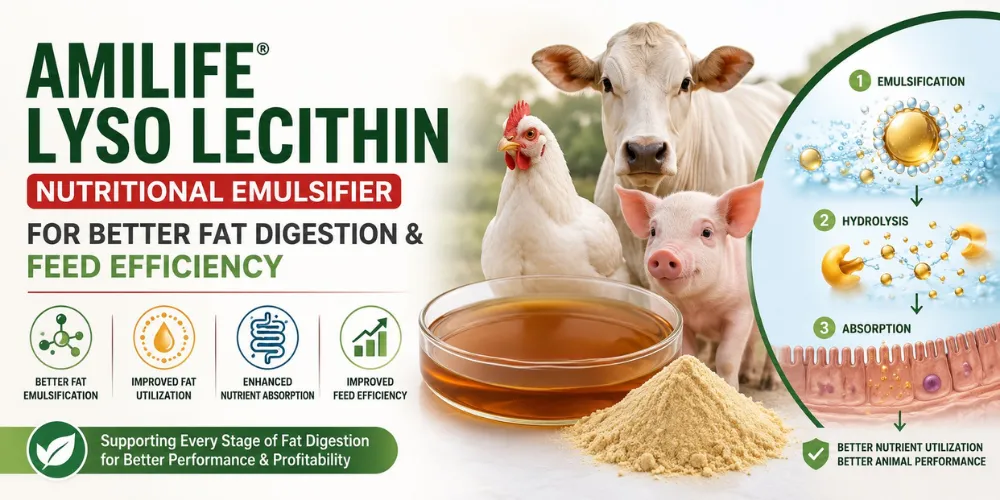
AmiLife® Lyso Lecithin: How a Nutritional Emulsifier Supports Fat Digestion and Feed Efficiency
Introduction: Why Fat Utilization Matters in Modern Feed Formulation
Feed efficiency is a major consideration in livestock and poultry production. Producers and nutritionists need to deliver adequate nutrients for growth and performance while carefully managing feed formulation costs.
Among the nutrients supplied through animal diets, fats and oils are important concentrated sources of dietary energy. However, the energy present in a fat source is only useful to the animal when that fat can be effectively digested, absorbed, and utilized.
This makes fat digestion and nutrient utilization important considerations when designing efficient feed programs.
AmiLife® Lyso Lecithin from Amitex is a nutritional emulsifier containing lysophospholipids, developed to support the digestion and absorption of dietary fats and fat-soluble nutrients in livestock and poultry feed.
But what exactly happens to dietary fat during digestion, and where can a nutritional emulsifier fit into this process?
Let's look at the science behind it.
What Is Lyso Lecithin?
Lyso Lecithin is a phospholipid-based ingredient containing lysophospholipids.
Phospholipids have both hydrophilic and lipophilic characteristics. This amphiphilic nature allows them to interact with both aqueous and lipid phases, making them useful in emulsification-related applications.
In animal nutrition, this property is relevant because dietary fat must be dispersed within the aqueous environment of the gastrointestinal tract before digestive enzymes can efficiently act on it.
AmiLife® Lyso Lecithin is positioned as a nutritional emulsifier designed to support this process.
The objective is not simply to add another ingredient to the feed. The important question is:
Can the animal efficiently access and utilize the energy and nutrients already present in the diet?
This is where understanding the fat digestion process becomes important.
Understanding the Three Key Stages of Fat Digestion
Fat digestion is a complex biological process. For a simplified understanding, it can be viewed through three interconnected stages:
1. Emulsification
2. Hydrolysis
3. Absorption
Each stage contributes to the animal's ability to utilize dietary fat.
1. Emulsification: Preparing Fat for Digestion
Dietary fats are hydrophobic, meaning they do not readily mix with water.
The gastrointestinal tract, however, is largely an aqueous environment.
During digestion, bile salts and other natural surfactant systems help disperse dietary fat into smaller droplets, creating an oil-in-water emulsion.
Why are smaller droplets important?
When a large fat mass is dispersed into smaller droplets, the total surface area available for interaction with digestive enzymes increases.
This gives lipase enzymes greater access to the triglycerides contained within the fat droplets.
Simplified process:
Dietary Fat
↓
Emulsification
↓
Smaller Fat Droplets
↓
Greater Surface Area for Enzymatic Action
A nutritional emulsifier such as AmiLife® Lyso Lecithin can support the emulsification environment involved in this process.
2. Hydrolysis: Breaking Down Dietary Fat
Once fat is adequately dispersed, digestive enzymes can act on the triglycerides.
One of the primary enzymes involved is lipase.
Lipase hydrolyzes triglycerides into smaller lipid components, including:
- Free fatty acids
- Monoglycerides
These products are subsequently involved in the formation of micelles, which are important for transporting lipid digestion products through the aqueous intestinal environment toward the intestinal surface.
The simplified reaction:
Triglycerides
↓
Lipase
↓
Free Fatty Acids + Monoglycerides
Efficient emulsification therefore plays an important supporting role because enzyme accessibility to the fat substrate is influenced by the available surface area.
3. Absorption: Making Digested Fat Available to the Animal
After hydrolysis, fatty acids, monoglycerides, and other lipid-soluble components associate with bile salts and other molecules to form micelles.
Micelles facilitate the movement of lipid digestion products through the intestinal environment toward the intestinal cell surface.
The lipid components can then be taken up by intestinal cells and further processed.
Simplified pathway:
Fatty Acids + Monoglycerides
↓
Micelle Formation
↓
Transport Toward Intestinal Cells
↓
Intestinal Absorption
↓
Nutrient Utilization
Efficient absorption is important because dietary energy and fat-soluble nutrients must ultimately become available to support physiological functions and animal performance.
Where Does AmiLife® Lyso Lecithin Fit Into Fat Digestion?
AmiLife® Lyso Lecithin is designed to support the emulsification stage of fat digestion, which can influence the conditions under which subsequent digestion and absorption take place.
Its lysophospholipid content provides amphiphilic properties that support interactions between lipid and aqueous phases.
The overall concept can be visualized as:
AmiLife® Lyso Lecithin
↓
Supports Fat Emulsification
↓
Smaller / Better-Dispersed Fat Droplets
↓
Improved Accessibility for Lipase
↓
Fat Hydrolysis
↓
Micelle Formation
↓
Nutrient Absorption
This is why Lyso Lecithin is commonly considered a nutritional emulsifier rather than simply a conventional feed ingredient.
Potential Benefits of Using Lyso Lecithin in Animal Feed
The value of a nutritional emulsifier should ultimately be considered in the context of nutrient utilization and feed formulation objectives.
AmiLife® Lyso Lecithin is designed to support several aspects of this process.
Better Fat Emulsification
Supporting the dispersion of dietary fat can increase the surface area available for interaction with digestive enzymes.
Support for Fat Utilization
Efficient emulsification can help facilitate subsequent enzymatic digestion of dietary triglycerides.
Support for Nutrient Absorption
Efficient fat digestion contributes to the availability and absorption of fatty acids, monoglycerides, and other fat-soluble nutrients.
Support for Feed Efficiency
When nutrients are effectively digested and absorbed, animals have greater opportunity to utilize the nutrients supplied through the diet.
Feed Cost Optimization Opportunities
Depending on the animal species, diet composition, nutrient specifications, and production objectives, nutritional emulsifiers can be incorporated into feed formulation strategies that aim to optimize nutrient delivery and potentially support diet reformulation.
Important: Actual performance and economic outcomes depend on multiple factors, including feed composition, animal species, age, health status, management conditions, fat source, and overall diet formulation. A nutritional emulsifier should therefore be evaluated as part of the complete feeding program rather than as a standalone solution.
Lyso Lecithin for Poultry and Livestock Nutrition
The efficiency of fat digestion can be particularly relevant when formulating diets for animals with specific energy requirements.
Poultry Feed
In poultry nutrition, dietary fats and oils can contribute substantially to the energy density of feed. Supporting efficient fat digestion can therefore be relevant when optimizing nutrient utilization.
Livestock Feed
In livestock nutrition, dietary energy utilization is similarly important for supporting growth and production objectives. The effectiveness of any emulsifier will depend on the complete diet and the animal's physiological and nutritional conditions.
For both applications, feed formulation should consider the complete nutrient matrix rather than focusing on a single ingredient in isolation.
Using AmiLife® Lyso Lecithin in Feed Formulation
One of the practical advantages of a nutritional emulsifier is its flexibility within a feed program.
AmiLife® Lyso Lecithin can be considered for:
Existing Diet Applications
It can be incorporated into an existing diet as part of a strategy to support fat digestion and nutrient utilization.
Nutritional Matrix Applications
Nutritionists can also consider Lyso Lecithin within a nutritional matrix approach.
A matrix strategy involves accounting for the expected nutritional contribution of an additive when designing or reformulating the overall diet.
This approach requires careful evaluation of:
- Animal species
- Age and production stage
- Dietary energy density
- Fat and oil sources
- Existing emulsification conditions
- Overall nutrient specifications
- Feed manufacturing process
- Farm management conditions
The objective is to create a balanced and economically sound feed formulation, rather than simply increasing or reducing individual ingredients.
What Makes an Effective Nutritional Emulsifier Important?
Not all feed formulations have the same nutritional challenges.
The effectiveness of an emulsifier can be influenced by several variables, including:
Fat Source
Different fats and oils have different physical and nutritional characteristics.
Diet Composition
Protein, carbohydrate, fiber, minerals, and other dietary components can influence the overall digestive environment.
Animal Species and Age
Digestive physiology changes between species and across different stages of animal development.
Feed Processing
Mixing, pelleting, storage, and application methods can influence how feed additives are incorporated into the final feed.
Management Conditions
Farm management, animal health, environmental conditions, and overall feeding practices can influence animal response.
This is why proper feed formulation and application are essential when evaluating nutritional emulsifiers.
AmiLife® Lyso Lecithin: Supporting the Nutrient Utilization Journey
A useful way to understand the role of AmiLife® Lyso Lecithin is to look at the complete nutrient-utilization pathway.
EMULSIFICATION
Supporting dispersion of dietary fats
↓
HYDROLYSIS
Supporting access for digestive enzymes
↓
MICELLE FORMATION
Supporting transport of lipid digestion products
↓
ABSORPTION
Supporting uptake of nutrients
↓
NUTRIENT UTILIZATION
Making dietary energy and nutrients available
↓
FEED EFFICIENCY
Supporting efficient utilization of the formulated diet
This doesn't mean that an emulsifier works independently of the animal's digestive system. Rather, it supports a biological process that is already occurring naturally during digestion.
Why Consider AmiLife® Lyso Lecithin?
For feed manufacturers and animal nutritionists, the key consideration is often how to get more effective nutritional value from a carefully formulated diet.
AmiLife® Lyso Lecithin provides a targeted nutritional emulsification approach based on lysophospholipids.
Its intended role is to support:
Fat Emulsification
Fat Digestion
Fat Utilization
Nutrient Absorption
Feed Efficiency
The practical value should always be assessed against the specific diet, animal category, and production objective.
Conclusion: A Smarter Approach to Fat Utilization
Efficient animal nutrition is about more than simply supplying nutrients. It is also about ensuring that animals can effectively digest, absorb, and utilize those nutrients.
Fats and oils are important energy-rich components of many animal diets, making efficient fat digestion an important consideration in feed formulation.
AmiLife® Lyso Lecithin is a nutritional emulsifier containing lysophospholipids, designed to support the emulsification, digestion, and absorption of dietary fats and fat-soluble nutrients.
From emulsification and hydrolysis to micelle formation and absorption, supporting each stage of the fat digestion process can contribute to better nutrient utilization and feed efficiency.
